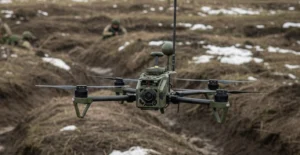
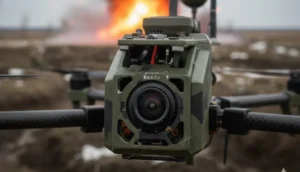
To ensure a stable link between the drone and the ground station, a transmitter and signal-enhancing antennas are installed on the drone frame. In this article, we examine the different types of equipment and the principles behind their operation. You can learn more about the features of setting up radio communication in the article about the lora protocol or expresslrs fpv.
Fundamentals of Video Link: VTX and VRX
FPV control relies on a video link. The main components are the video transmitter (VTX) on the drone and the receiver (VRX) in the operator’s goggles or on the ground station monitor.
The video transmitter (VTX) is mounted in the central part of the drone frame, typically above the FPV payload module. This position, with secure fixation, prevents vibration that could impair device performance. The transmitter is connected to the video camera, from which it receives the video signal and transmits it to the operator using a selected frequency. Additionally, the device may support automatic frequency search and band scanning to maintain a channel with minimal interference and congestion.
Some video transmitters can automatically adjust transmission power. Power is measured in mW and directly affects signal range, the ability to penetrate obstacles such as concrete walls, and the delivery of clear, detailed video. The transmitter is powered by the onboard battery. If the transmission power is too high, the unit heats up, requires cooling, and increases power consumption. As a result, the battery discharges more quickly, reducing flight range.
Frequency Bands: 5.8 GHz vs 1.2/1.3 GHz
Frequency is related to wavelength. The lower the frequency, the longer the wave. Lower frequencies provide a more stable signal over long distances and better obstacle penetration. Higher frequencies (shorter waves) can transmit more information but are less suitable for complex terrain.
To ensure high data rates and interference resistance in FPV communication with the operator, antennas operate in the most effective frequency bands, such as:
- 5.8 GHz. The primary standard for open terrain. Enables fast data transmission with minimal latency and high-quality detailed video. Due to limited penetration capability, it is less suitable for long flights with obstacles.
- 1.2/1.3 GHz. Preferred for stable signal transmission over long distances with obstacles such as uneven terrain and trees. Requires larger antennas, suitable for bigger drones. This frequency is more compatible with analogue systems.
The antenna’s frequency band should be selected according to mission conditions rather than individual technical parameters alone.
Antenna Types and Polarisation
An FPV antenna transmits and receives radio waves within a specific frequency range corresponding to its design. The video transmitter generates the signal; the antenna merely radiates it. The key characteristic of an antenna is its polarisation (the direction of radio wave oscillation), which can be linear or circular. It is important that the transmitter and receiver antennas use the same polarisation.
For short-range FPV flights, circularly polarised antennas are preferred because they provide stable signal performance even during manoeuvres and in adverse weather. For long-distance flights, linear polarisation with higher directional gain is often more suitable.
LoRa (Long Range) is an energy-efficient radio communication technology over long distances. It adapts the data transfer rate according to the request for the quality of the result and depending on the distance to the receiver. It enables reliable contact even in the presence of interference. LoRa uses linear frequency modulation of signals, therefore it ensures their better quality without the influence of noise and interference.
Omnidirectional and Directional Antennas
Drone antennas can be directional (helical and patch antennas) or omnidirectional. Directional antennas radiate the signal in a single direction within a limited coverage plane but provide high stability. Omnidirectional antennas can transmit and receive signals in multiple directions during short-range flights; however, they still have zones of lower gain where the signal is weaker.
FPV drones most commonly use omnidirectional circularly polarised antennas (RHCP/LHCP). These ensure signal stability even in the presence of obstacles such as buildings, trees, or other physical barriers. Directional circularly polarised antennas, known as helical antennas, are better suited for long-range flights. They cover wide frequency ranges and offer high gain.
| Antenna Type | Directionality | Advantages |
Disadvantages |
| Omnidirectional (Omni) | 360 degrees | Stable signal in any drone orientation | Limited communication range |
| Patch Antenna (Patch) | Directional (sector) | Long range within the sector | Signal is lost outside the viewing angle |
| Helical | Narrow directional | Maximum range and penetration | Requires precise alignment with the drone |
The most effective configuration is to use drones with two antennas employing diversity technology. This provides a stable signal at short distances via the omnidirectional antenna and automatically switches to the directional antenna (patch) for long-range flights, delivering a stronger signal under such conditions.
Omnidirectional antennas are best suited for manoeuvring flights nearby, including between buildings. A common example is the universal multi-purpose Cloverleaf antenna, named for its compact, three-leaf shape. Another design resembles a mushroom form.
The Pagoda antenna features circular polarisation. Its multi-layer structure creates phase shifts between fibreglass layers, achieving maximum field uniformity and allowing the signal to pass confidently through obstacles. The Pagoda demonstrates excellent penetration resistance but has greater weight.
For long-range flights, compact and efficient directional patch antennas or helical antennas aimed in a specific direction are more appropriate.
The Concept of the Radio Horizon
There is an objective limitation to the distance over which a radio signal can be transmitted, defined by the concept of the radio horizon. Radio waves travel in a roughly straight line, and due to the Earth’s curvature, the signal is eventually lost beyond a certain distance. This portion of the route is called the radio horizon, or “line-of-sight range”, and is influenced by environmental features, terrain, and atmospheric conditions. Any obstacle (for example, a hill) can reduce the radio horizon.
The radio horizon can be extended by flying at higher altitude above sea level. At the same distance, lowering the drone may cause both video and control signals to disappear. To further increase communication range, the receiving antenna can be raised on a mast. You can significantly increase the flight range and stabilize the signal in the conditions of electronic warfare operations using a round station repeater.
The Impact of Electronic Warfare on Video Signal
Electronic warfare systems detect drones and create interference for video links and control signals through radio emissions in the form of noise. This interference can degrade video quality, introduce delays, or completely disrupt the signal, leading to impaired targeting and loss of drone control. EW systems vary in operating principles and range.
Knowing what an FPV drone is and how it works it possible to minimise interference by using relay drones that accompany strike UAVs and amplify their signals. It is also possible to change frequencies and prioritise the use of directional antennas.