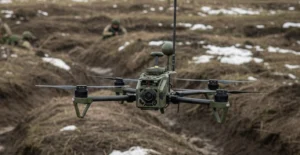
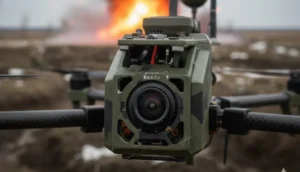
Cameras for FPV Drones To provide real-time FPV video communication between the drone and the operator with minimal latency, specialised video cameras are used. The device is mounted at the front of the drone frame, angled slightly towards the horizon and positioned above the FPV payload modules so that other components do not obstruct the view. In this article, we examine the latest technologies and camera features critical for military applications.
The Camera as the Pilot’s Primary Sensor
An FPV camera must transmit video as quickly as possible. FPV drones are a mission within the assault groups of the Armed Forces of Ukraine, so they must accurately hit the target and respond rapidly to changing circumstances. The realism of the flight is achieved through First Person View technology. Video goggles or helmets incorporate sensors (head trackers) that synchronise the operator’s head movements with the camera angle and lens adjustments, creating an immersive experience as if the operator is onboard the drone.
Analogue and digital cameras are specifically designed for FPV drones, offering excellent stabilisation and wide-angle lenses. The material on digital vs. analog video modules will help you compare their characteristics in more detail. Analogue cameras are cheaper and provide almost instantaneous transmission but are sensitive to noise, resulting in lower image quality. They are suitable when rapid response is paramount. Digital cameras provide detailed, high-quality images but may suffer interruptions or inaccuracies in poor signal conditions due to missing data.
Depending on video quality requirements, camera specifications may vary, including image stabilisation level, automatic correction of irregularities, resolution, focal length, and power consumption.
Key Characteristics of FPV Cameras
The main specifications of FPV cameras include:
- Clarity: Measured in television lines (TVL). Higher values indicate greater clarity and the ability to see fine details. High clarity is considered 1200–1500+ TVL.
- Light Handling: Provided by WDR (Wide Dynamic Range) technology, which balances brightness when the drone moves from shadow into sunlight, enhancing image clarity.
- Field of View (FOV): Typically 120°–170°, optimal for situational awareness and precise orientation. Ultra-wide-angle lenses are possible, but they distort distances and bend the edges of the image, creating a “fish-eye” effect.
- Latency: The time interval between what the camera sees and what appears on the pilot’s display. Latency should not exceed 20 ms, with 5 ms considered optimal. Excessive latency may cause collisions, mistaken payload releases, or trajectory errors due to delayed commands.
- Light Sensitivity: The ability to see in partial or total darkness. For twilight filming, a camera with sensitivity below 0.001 Lux is required, such as the night camera of the SKY LINK-OS01 relay drone with 0.00001 Lux sensitivity.
A high-quality camera allows the operator to control the drone effectively and complete assigned tasks.
| Camera Type | When to Use | Main Advantage | What the Pilot Sees |
| Day | Bright daylight | Cheap and clear | Realistic colour image |
| Starlight | Twilight, overcast | Works in minimal light | Clear image even in deep shadow |
| Night | Complete darkness | Operates without lighting | High-detail black-and-white image |
| Thermal | Any time (target search) | Detects heat | Hot objects (engines, people) on a cold background |
Specialised cameras can operate continuously, automatically adapting to changing lighting conditions. Full darkness requires thermal cameras or infrared illumination.
Daytime Cameras: Bright Conditions
Daytime cameras prioritise contrast and accurate colour reproduction, enabling rapid detection of camouflage. CCD sensors and white balance technology ensure high-quality images, while gyroscopes stabilise the horizon.
Low-Light Cameras (Starlight)
Starlight technology ensures high colour sensitivity, making night footage appear as if recorded in daylight. Image clarity can reach up to 4K, producing a bright and comprehensible picture. An option to switch to black-and-white mode enhances clarity in darkness.
Night and Thermal Cameras
For twilight, dawn, or moonlit night operations, cameras with high light sensitivity, CMOS sensors, and WDR technology are used. For complete darkness, thermal cameras (infrared sensors) detect heat from engines, vehicles, or personnel. The sensor converts heat into an electrical signal, which the camera renders visually, showing temperature differences in colour for objects that the human eye cannot see. Drones can carry full night-vision systems or integrate thermal modules alongside a daytime camera.
Adapting Settings for Frontline Conditions
The classification of FPV drones used by the Armed Forces of Ukraine helps in selecting the appropriate camera. It is important to consider the frame size and the drone’s combat role, as the camera’s power consumption and weight directly affect flight range and speed. Regardless of format, the camera must provide high resolution to produce a clear, detailed image. A key decision is whether to prioritise image detail and quality (digital signal) or transmission speed, even if accompanied by noise (analogue signal).
The most critical camera settings for FPV drones employed in military and tactical missions are resistance to sun glare and rapid adaptation when moving from shadow into bright light without blinding the image. Therefore, the presence of WDR (Wide Dynamic Range) technology is essential, as it ensures high-contrast imagery in challenging lighting conditions. The WDR value should exceed 120 dB.