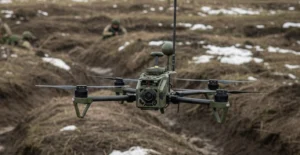
FPV drone is a combat drone with a first-person view (FPV) provided by an onboard camera. This article explains how FPV drones operate, the specifics of their design, and how they differ from other types. You will learn what tasks can be carried out using FPV drones. You can learn more about the types and purposes of these devices in the article on the classification of FPV drones of Ukraine used by the Armed Forces.
Definition of FPV (First Person View)
The term “first-person flight” originates from model aircraft engineering. Engineering concepts combined with radio technology made it possible to use radio waves to control aircraft, including drones and other unmanned systems. More practical tips for novice operators are collected in the article on how to control a drone.
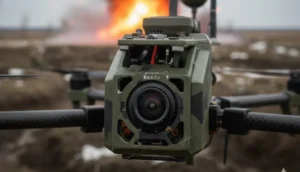
The name implies that the operator pilots the drone remotely while observing the surrounding area through live video transmitted by the camera mounted on the drone to a monitor or FPV goggles. High-tech cameras may feature a tilt mechanism or optical stabilisation to compensate for vibration and movement, ensuring a clear image. A ground station is used to receive the signal. The stability and range of video signal transmission directly depend on the characteristics of the equipment, in particular on what an FPV antenna is and what its parameters are.
FPV flights were already popular in the 2010s, often for panoramic filming. With the outbreak of the war in Ukraine, drones became an essential part of military operations. Adapting FPV systems to the needs of Ukrainian Armed Forces units has enabled remote reconnaissance, destruction of enemy vehicles, fortifications, structures, and more. In combat applications, it is also important to consider FPV tactics during assaults and interaction with assault teams.
Operating principle: pilot immersion
The operator receives video with minimal latency (near real time). The quality and informational value of the video depend on the display characteristics, signal quality, and the camera’s field of view. The clearer and more stable the image, the more precise the control.
The operating principle is as follows:
- The drone is equipped with a video camera that transmits real-time data via a video transmitter (VTX).
- FPV goggles or a ground station monitor used by the operator receive the signal through a video receiver (integrated or modular).
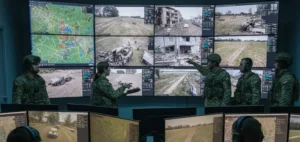
- Ground station equipment may provide different display options: a computer monitor, dual displays in FPV goggles, or a single display in a helmet, depending on the configuration.
By observing the live video, the operator can rapidly adjust the drone’s trajectory according to changes in the operation, manoeuvre precisely, react to unexpected events, and guide the aircraft towards a target while avoiding obstacles. Several flight modes are available, the most common being self-levelling and Acro (manual) mode.
Acro mode is used when high manoeuvrability is required. The operator has full control and continuously pilots the drone using the transmitter. If direction and speed are set and the controls are released, the drone will continue executing the command without returning to a neutral position, so it is important to manually return it to a safer attitude (for example, level flight).
Anatomy of a combat FPV drone
An FPV drone typically has a lightweight and durable quadcopter design with four propellers, each capable of independent speed adjustment to change the aircraft’s position in the air. Payload modules play a special role in the design, in particular various types of combat units for FPV drones, which determine their functional purpose.
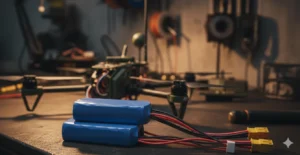
All components are mounted on a strong, lightweight carbon fibre frame with four arms, each holding a propeller driven by a brushless motor. At the centre of the frame is the housing containing control boards, the battery powering the motors, the camera, and the video transmitter.
Flight stability and precise response to commands are ensured by the flight controller (FC) with sensors (accelerometer, gyroscope, barometer, etc.). The FC analyses operator inputs and sensor data and, with minimal delay (FPV latency typically around 10–40 ms), stabilises the aircraft, enables various flight modes, regulates motor performance, maintains altitude, sets direction, and ensures the operation of all system components.
The FC is an electronic board composed of modules responsible for different functions. It processes data and issues instructions via the onboard microprocessor. Microprocessors vary in performance, and different firmware determines the system’s functional capabilities.
According to received commands, the flight controller sends signals to the electronic speed controllers (ESCs), which adjust the rotation speed of the propellers, accelerating or slowing the drone.
Motors determine the drone’s efficiency, flight duration, power, and speed. Considering the combat payload, the drone’s thrust should be at least twice its weight to allow confident lift and manoeuvrability. High thrust is achieved through powerful motors and larger propellers, or more precisely, their rotational speed. Propellers also contribute to stability and efficient battery use. They may vary in blade count (two-blade, three-blade, or more), diameter, and pitch, affecting speed and handling.
Why FPV is not a “Mavic”: key differences
FPV drones are more agile, faster, and more powerful compared to DJI Mavic series drones, which are typically used for reconnaissance, fire adjustment, and thermal imaging with high-quality video capture. FPV drones are capable of precise strikes and navigating complex routes.
Main advantages:
- Direct and precise operator control (without autopilot);
- High manoeuvrability, speed, ability to enter dugouts and hatches, and attack from various angles;
- Ease of repair.
Although FPV cameras are generally lower in quality compared to Mavic cameras, they still provide detailed imagery with minimal latency. FPV drones are also significantly more affordable.
Combat application and task types
According to their functional classification for the Armed Forces, FPV drones can be divided into:
- Kamikaze drones – equipped with a munition effective even against armoured vehicles and designed for single-use strike missions with self-destruction.
- Bomber drones – fitted with a release mechanism for precise dropping of munitions, including for area mining. These can be reused during operations but risk being shot down on return.
- Low-altitude reconnaissance drones – capable of recording video day or night while flying close to the ground, using trees and structures for cover.
There are also multi-purpose models that can be reconfigured as needed. Equipping a drone simultaneously with a camera and a release mechanism enables it to function both as a reconnaissance unit and a bomber when required.
Battlefield effectiveness
One of the greatest advantages of FPV drones is their low cost and high effectiveness. A strike system costing around $500 can destroy equipment and structures worth millions. Thanks to their modular design, drones are relatively easy to assemble and can even be built in field conditions if components and soldering equipment are available. While many components are produced in semi-improvised conditions, it is preferable to use products with assured quality.
SkyCraft supplies FPV drones and develops and tests unique modifications for specialised combat tasks of the Armed Forces of Ukraine. We manufacture drones adapted to electronic warfare conditions and take into account customer requirements such as payload type, flight range, and mission purpose.