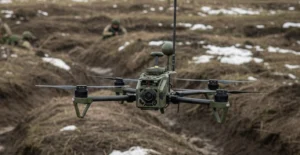
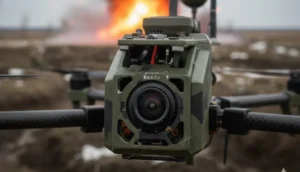
FPV (First Person View) drones rely on several key control systems working together to ensure precise piloting. This article explains what a FPV drone, how the drone interacts with the operator, and the different types of control systems used.
How commands are transmitted from the pilot to the drone
Information from the operator to the drone is transmitted through the chain: transmitter (TX) → protocol → receiver (RX).
FPV drones are controlled from a ground control station which, in its basic configuration, consists of a transmitter, video receiver, antenna, display devices (monitor, goggles, or helmet display), and a power source. The station may be portable with an integrated screen or stationary with a dedicated operator’s workspace. In all cases, it includes equipment that establishes a communication channel between the operator and the UAV.
Transmitters feature control elements (switches, joysticks, rotary controls) whose movement corresponds to specific commands. When the operator performs the required actions, the TX converts them into signals, encodes them, and sends them to the UAV. Since FPV drones do not include automated flight stabilisation or autopilot, and every manoeuvre and action is determined by the operator, piloting skills are critical.
Control signals are transmitted via a digital protocol with multiple channels, each carrying a specific command. A protocol defines the rules for signal transmission. Although many protocols exist, the most widely used are ExpressLRS (ELRS) and TBS Crossfire (TBS).
On board the UAV, a receiver (RX) for analogue or digital signals forwards the data to the flight controller (FC). The FC — a modular electronic board with a microprocessor — processes and interprets the data, changes flight modes, adjusts altitude, directs the drone, and executes commands. FPV antennas and transmitters operate in accordance with the rules defined by the control protocol.
You can read more about the principle of operation of these devices in the material about what is vtx or what is vrx.
ExpressLRS (ELRS) protocol: the new standard
ExpressLRS is currently the most popular protocol. It is open-source, allowing extensive configuration without restrictions, and is frequently updated. Its advantages include near-zero latency, long communication range even at moderate transmitter power, and low cost.
ELRS is compatible with 2.4 GHz and 868/915 MHz frequencies. The 2.4 GHz band provides considerable range but is better suited to open terrain due to lower penetration through physical obstacles.
For environments with buildings and obstructions, lower-frequency bands such as 868/915 MHz are preferable, offering greater range and better resistance to interference. However, these frequencies provide slower data transmission.
Due to the optimal balance between range and transmission speed, these frequencies have become standard within the Armed Forces of Ukraine, enabling FPV systems to be adapted to operational needs.
TBS Crossfire: a reliable classic
A slightly less flexible but highly stable protocol is TBS Crossfire, known for low latency. It is part of the TBS ecosystem, easy to configure, capable of very long range, and resistant to interference and noise. It operates exclusively on the 900 MHz band and is more expensive than ELRS.
Crossfire is a closed protocol, meaning its internal structure is not publicly accessible and custom configurations are not possible. However, the developers have carefully addressed user needs, and the system reliably meets most operational requirements. User feedback often highlights its simplicity compared to ELRS.
LoRa technology: the secret to long range
LoRa (Long Range) is an energy-efficient radio communication technology for extended distances. It dynamically adjusts data transmission speed depending on signal quality requirements and distance to the receiver. LoRa uses linear frequency modulation, ensuring high signal quality and resistance to interference and noise, even in obstructed environments.
ELRS vs Crossfire for combat use
ELRS is more affordable and accessible, with firmware that is continuously updated. It supports over 14 data types but does not include encryption, meaning transmitted data is not protected. Crossfire introduces slightly higher latency and cost but offers broader telemetry capabilities, seamless integration, and exceptional stability. Its simple configuration and ease of use are significant advantages.
| Characteristic | ExpressLRS (ELRS) | TBS Crossfire |
| Frequencies | 2.4 GHz / 868–915 MHz | 868–915 MHz |
| Openness | Open-source (free software) | Closed ecosystem |
| Update rate | Up to 1000 Hz (minimal latency) | Up to 150 Hz |
| Resistance to interference | High (flexible configuration) | High (stable modulation) |
| Setup complexity | Medium (requires flashing) | Low (plug & play) |
| Cost | Affordable (low receiver cost) | Higher (brand and reliability) |
It is important to note that a drone configured for ELRS is not compatible with TBS equipment, and vice versa.
Transmitter power and pilot safety
Transmitters are a critical part of the FPV system, as they carry the video signal from the drone’s camera to the ground station display (monitor, goggles, or helmet). Devices vary in output power, which determines their effective range. Even fibre-optic drones, such as the SkyCraft FOC-15.20-25, use these protocols to ensure precise remote control without risk to the operator, who remains at a safe distance from the operational area.
In combat conditions, ground stations are often located inside shelters or dugouts. Walls and structures can attenuate signals and reduce effective transmitter performance. To maximise technical capability, external or elevated antennas are commonly used.